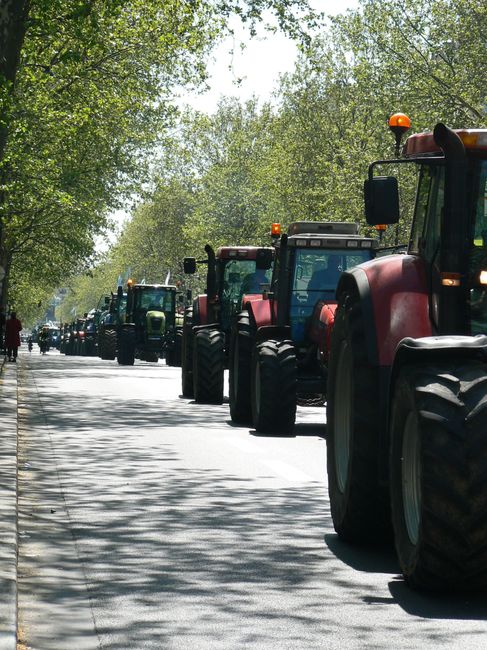
Paris, France – The heart of the French capital ground to a standstill on [Date – Insert the current or a plausible future date], as thousands of farmers, driving convoys of tractors, descended upon Paris in a dramatic protest against the proposed EU-Mercosur free trade agreement. The demonstration, which has caused widespread traffic disruptions and significant economic impact, reflects growing discontent within the agricultural sector over the potential consequences of the deal.
Farmers' Fury: A Deal Seen as a Death Knell
The EU-Mercosur free trade agreement, negotiated between the European Union and the Mercosur bloc (comprising Argentina, Brazil, Paraguay, and Uruguay), aims to eliminate tariffs on a wide range of goods. While proponents highlight the potential for increased trade and economic benefits, French farmers, along with their European counterparts, fear that the deal will undermine their livelihoods. They argue that the agreement unfairly exposes them to competition from Mercosur producers who often operate under less stringent environmental and labor regulations, leading to lower production costs and potentially flooding the European market with cheaper goods.
"This agreement is a death sentence for European agriculture," declared Jean-Pierre Dubois, a livestock farmer from Normandy, speaking at the Place de la Bastille, one of the protest's focal points. "We cannot compete with producers who are not held to the same standards. This will bankrupt us, plain and simple." Farmers are particularly concerned about the impact on beef, poultry, and grain producers, who anticipate a surge in imports from South America.
Environmental Concerns Fuel Opposition
Beyond economic anxieties, environmental concerns are also driving the widespread opposition. Farmers argue that the EU-Mercosur agreement could incentivize deforestation in the Amazon rainforest and other sensitive ecosystems in South America, due to increased agricultural production. They point to the lax enforcement of environmental regulations in some Mercosur countries and express fears that the deal could worsen climate change and biodiversity loss. Protesters displayed banners criticizing the environmental impact of industrial farming in the Mercosur region, calling for stricter enforcement of sustainability standards.
Political Pressure Mounts on European Leaders
The unprecedented scale of the farmers' protest has put immense pressure on European leaders and the European Commission. The French government, already facing growing discontent over rising living costs and perceived governmental inaction, is acutely aware of the political ramifications. President [Insert French President's Name] is expected to address the issue in the coming days, facing demands for a reassessment of the trade deal or, at the very least, robust safeguards to protect European farmers.
Similar protests and expressions of concern have been voiced across other EU member states, including Ireland, Germany, and the Netherlands. This unified front suggests a growing consensus among European farmers that the EU-Mercosur agreement, as currently drafted, poses an unacceptable threat to their future.
Negotiations at a Standstill? Implications for Global Trade
The tractor protest in Paris comes at a critical juncture in the negotiations. While the EU has been keen to finalize the deal, the farmers' resistance throws its future into doubt. The European Commission may be forced to renegotiate key aspects of the agreement, adding new safeguards for European producers or imposing further environmental conditions on Mercosur imports. Failure to address the farmers' concerns could result in protracted delays or even the ultimate collapse of the deal, with significant implications for global trade and geopolitical relationships.
The situation remains fluid, but one thing is clear: the farmers' revolt in Paris has sent a powerful message to Brussels, underscoring the vital importance of agriculture to the European economy and the political risks associated with trade agreements perceived as detrimental to its well-being. The coming days and weeks are likely to determine the future of the EU-Mercosur trade deal and reshape the landscape of European agriculture.
Comments
Post a Comment